Shringa KMJune 4, 2026
As software testing becomes faster and more complex, QA engineers are increasingly using AI tools to reduce repetitive work, improve productivity, and enhance test quality. But AI is only as useful as the instructions given to it. This is where Prompt Engineering becomes important.
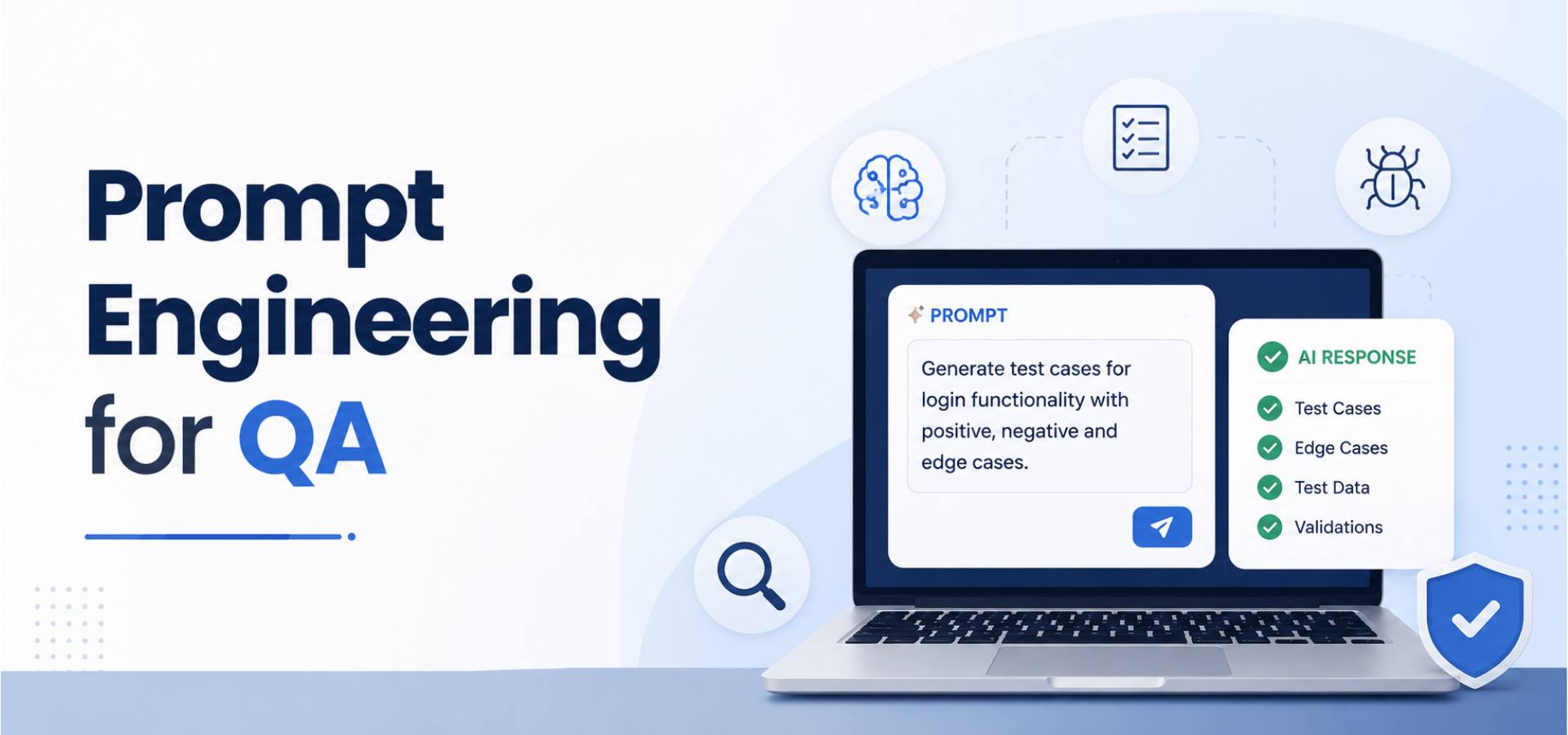
Prompt Engineering is the practice of writing clear and effective instructions (prompts) for AI tools to get accurate, relevant, and high-quality results. For QA professionals, well-written prompts can save time, improve test coverage, and help detect defects faster.
Prompt Engineering in QA means designing smart prompts that guide AI tools to assist in software testing activities such as:
A better prompt gives better output, which directly impacts testing speed and quality.
Instead of manually writing test cases, QA engineers can ask AI to generate structured test scenarios.
Example Prompt:
"Generate positive, negative, and boundary test cases for a login page with email and password fields."
This reduces manual effort and speeds up planning.
AI can help analyze logs, error messages, and defect reports.
Example Prompt:
"Analyze this API failure and list possible root causes for HTTP 500 error during payment processing."
This helps QA identify issues faster.
Many defects hide in uncommon scenarios. AI prompts can uncover them.
Example Prompt:
"List unexpected edge cases for a sales order creation feature in offline and online mode."
This improves test coverage.
QA often creates reports, summaries, and release notes.
Example Prompt:
"Summarize test execution results and highlight critical failed scenarios."
This saves reporting time.
Vague prompts produce vague results.
Bad Prompt:
"Give me test cases."
Better Prompt:
"Generate boundary value test cases for quantity fields allowing values 1–100."
Mention module, environment, or business flow.
Example:
"Generate negative API test cases for Sales Order creation when the network fails during sync."
Ask for output style.
Example:
"Create test cases in table format with scenario, steps, expected result, and priority."
Mention platform, rules, or conditions.
Example:
"Generate UI validation test cases for mobile app login screen under slow network conditions."
AI can create:
Prompts can help generate:
Prompt engineering can help:
AI prompts can summarize:
Lack of detail may give incomplete results.
AI may misunderstand the business scenario.
Always validate generated results.
Ask AI specifically for abnormal or rare scenarios.
Prompt Engineering is becoming a valuable skill for QA engineers. Writing better prompts helps AI deliver faster, clearer, and more accurate testing support. From test case creation to bug analysis and automation assistance, well-structured prompts can improve both testing speed and software quality.
For QA teams, learning how to ask better questions can become just as important as knowing how to execute tests. In modern testing, smarter prompts can lead to smarter QA.
Yes, it can reduce time spent on repetitive tasks like writing test cases, preparing reports, and generating test scenarios.
Well-written prompts can help identify edge cases, generate structured test scenarios, highlight missing validations, and support more accurate defect analysis.
It can help generate script ideas, improve assertions, suggest locators, optimize test logic, and support automation framework improvements.
Yes. By asking targeted prompts, QA engineers can explore uncommon, risky, or unexpected scenarios that may be missed during manual planning.
Common mistakes include vague prompts, missing context, unclear expectations, and relying on AI output without validation.





0