Flutter gives you freedom. That freedom is powerful—but it also causes confusion, especially when it comes to app architecture.
If you search online, you’ll see endless debates about MVC vs MVVM vs Clean Architecture in Flutter. Most of them repeat theory, show fancy diagrams, and avoid the real question:
What actually works when you’re building and maintaining a Flutter app?
This blog answers that—clearly and honestly.
Why Flutter Architecture Debates Are Often Misleading
Most architecture discussions come from Android, iOS, or web backgrounds. Flutter is different.
Flutter:
Is widget-first
Encourages reactive UI
Does not enforce any architecture
Because of this, copying an architecture blindly often creates more problems than it solves.
This blog won’t sell you a “perfect” architecture. Instead, it explains what each approach looks like in Flutter, where it fails, and when it actually makes sense.
How Flutter Really Works (Before Choosing Any Architecture)
Before comparing architectures, you need to understand one thing:
In Flutter, everything starts and ends with widgets.
Widgets:
Render UI
React to state changes
Often hold UI-related logic
Flutter uses unidirectional data flow:
State changes
UI rebuilds
User interacts again
Flutter does not separate View and Controller for you. That separation is your responsibility, not the framework’s.
This is why some traditional architectures feel unnatural in Flutter.
MVC in Flutter: Why It Feels Forced
What MVC Means (In Simple Terms)
MVC stands for:
Model – data
View – UI
Controller – business logic
This works well in frameworks where views are passive. Flutter views (widgets) are not.
Why MVC Breaks Down in Flutter
In Flutter:
Widgets already handle UI logic
Controllers often become massive
Logic leaks into widgets anyway
What usually happens:
“Controllers” turn into dumping grounds
Widgets still manage state
Separation becomes theoretical, not real
This leads to:
Hard-to-test code
Tight coupling
Confusing ownership of logic
When MVC Might Still Be Okay
MVC is not evil—it’s just limited.
Use MVC only if:
The app is very small
The lifespan is short
Speed matters more than maintainability
For anything serious or long-term, MVC will slow you down later.
MVVM in Flutter: Popular, Useful, but Often Misunderstood
What MVVM Means in Flutter
In Flutter terms:
View → Widget
ViewModel → State holder + logic
Model → Data / domain objects
MVVM works better in Flutter because:
UI reacts to state
Logic stays outside widgets
Widgets remain cleaner
Common MVVM Approaches in Flutter
Most Flutter MVVM apps use:
Provider
Riverpod
Sometimes Bloc or Cubit (MVVM-like)
Important truth:
Most Flutter apps use MVVM-style, not pure MVVM.
And that’s okay.
Pros and Cons of MVVM in Flutter
Pros
Cleaner widgets
Better testability
Clear separation of UI and logic
Cons
Extra boilerplate
Can feel heavy for small apps
Easy to overdo abstraction
MVVM is a solid default choice for many Flutter projects.
Clean Architecture in Flutter: Powerful, Expensive, and Often Misused
Clean Architecture Is Not a Pattern
This is where many blogs get it wrong.
Clean Architecture is:
A set of principles
Focused on dependency direction
About separation of concerns
It is not a fixed structure you copy-paste.
Typical Clean Architecture Layers in Flutter
Most Flutter implementations use:
Presentation – UI + state management
Domain – business rules and use cases
Data – APIs, databases, repositories
Dependencies always point inward.
Benefits of Clean Architecture
Clean Architecture shines when:
The app is large
Teams are growing
Testing matters
Business logic is complex
You gain:
High testability
Long-term maintainability
Clear boundaries
When Clean Architecture Is a Bad Idea
Let’s be honest.
Clean Architecture is a mistake if:
The app is small
The team is tiny
Deadlines are tight
Requirements change daily
Over-engineering early is one of the most common Flutter mistakes.
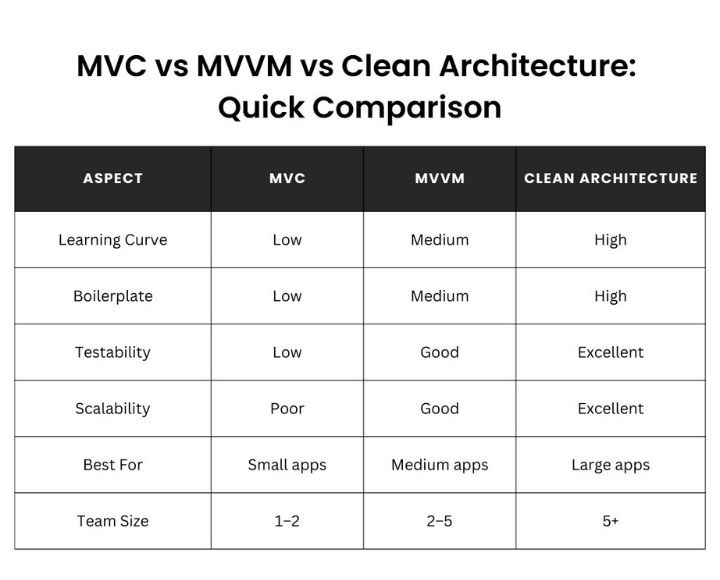
Which Architecture Should You Choose?
Choose MVC if:
App is tiny
Built fast
Not expected to grow
Choose MVVM if:
App has real UI logic
Needs testing
Team is growing
Choose Clean Architecture if:
Enterprise-level app
Long-term support
Multiple teams involved
There is no universal winner—only context.
Real-World Flutter Project Structure Examples
MVC (Simple)
MVVM
Clean Architecture
No architecture fixes bad code. Structure only helps a gooddiscipline scale.
Common Flutter Architecture Mistakes
Starting with Clean Architecture too early
Copying YouTube tutorials blindly
Mixing patterns without rules
Ignoring team experience
Optimizing for theory instead of delivery
Architecture should reduce friction, not add it.
Final Verdict: Architecture Is a Tool, Not a Badge
The best Flutter architecture is the one that:
Your team understands
Matches the project size
Can evolve over time
MVC, MVVM, and Clean Architecture all have a place—but only when used intentionally.
If you’re building Flutter apps for real users and real businesses, clarity always beats complexity.









3